Walk on the left, stand on the right – A considerate city moves faster. Literally.
We’ve all been there: you’re rushing to catch a train or plane, counting down the minutes while weaving through pedestrians and traffic, legs and lungs burning from the effort. You cycle up to the station, arms cramping from trying to balance a bag on your shoulder while pushing your bike onto the escalator. Just when you start to feel a sense of relief that you’ll make it on time… halt. You’re trapped, someone has planted themselves in the middle, oblivious, and an entire line is forced to shuffle at their pace, or not at all. “Really? Just stand there? No, please, make yourself at home”. Every Amsterdammer knows the feeling: that surge of frustration when collective movement crashes into a wall of individualism.
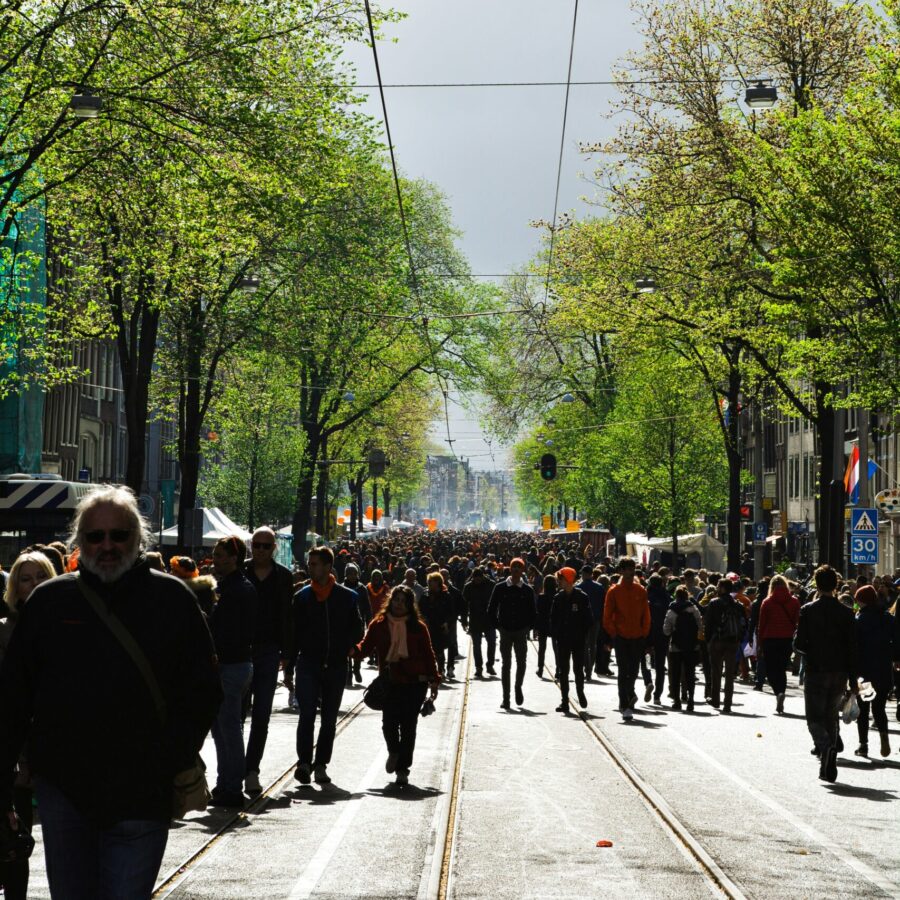
And it’s not just escalators. Out on the streets, walking in Amsterdam is less a stroll than a survival sport: few are willing to step aside, so your choices are collision, or stepping into the road – and straight into roadkill. It’s a case of urban ‘tunnel vision’ gone viral: eyes are glued to screens, AirPods sealing off the world, efficiency gains maximized as people on electric bikes and scooters or in cars slice past at full speed.
These might feel like minor irritations. But in a city built on constant motion, it’s more than that. Amsterdam, like many capitals, thrives on flow: pedestrians and bikes threading through narrow streets, trams and cars gliding past, people moving in and out of the station like bees to and from a hive. Our collective rhythm depends on thousands of micro-movements and the synchronicity with which we switch between locations and modes. Let’s not even start calculating what that pause costs in lost time across a city. When one person blocks this flow, the effect ripples out.
The deeper problem isn’t logistics – it’s mindset. Blocking an escalator or sidewalk suggests: my convenience comes first. It’s a small act of disregard, but when multiplied daily across thousands of journeys, you cannot help but wonder: are these subtle moments part of a wider trend toward individualism in our culture, where personal comfort increasingly outweighs collective consideration? Courtesy in public space isn’t about rigid rules – it’s about consideration and empathy. When we ignore flow in shared spaces, we chip away at the collective spirit that makes cities work.
The takeaway? Keep moving on the travellator, keep right on the escalator, and look around when walking: these gestures cost nothing, yet they give everyone back a bit of freedom. The city works only if we all do our part – so step aside, and keep it flowing.